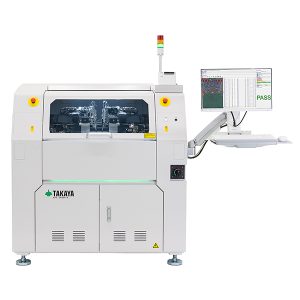
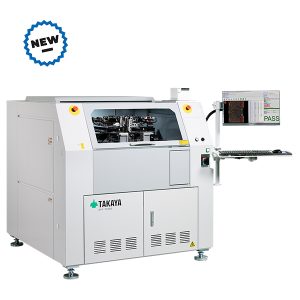
By analysing real-life applications already handled by the Takaya APT 1400F and APT 1600FD series, we can now envision how the new APT 2400F and APT 2600FD flying probe testers may take these use cases even further. This perspective highlights potential gains in efficiency, speed and accuracy for PCBA testing – from rapid prototyping to high-mix, high-volume production.
Additionally, the fixtureless nature of flying probe technology remains a key advantage over bed-of-nails testers, offering greater flexibility and reduced implementation costs.
Case Study 1: Improving Efficiency with In-Line Testing Applications
Increased Repeatability and Speed
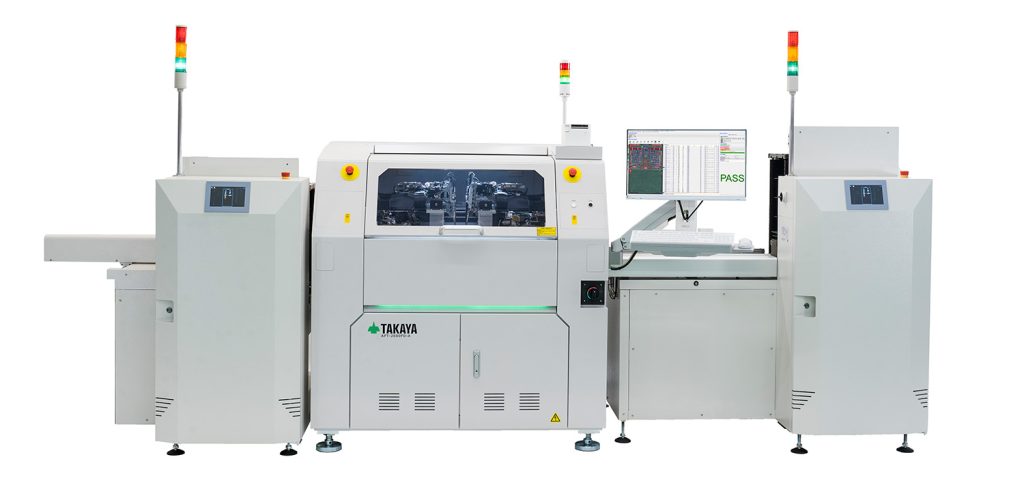
One of the major advances in Takaya’s latest generation of flying probe testers lies in the improved repeatability of in-line testing. While in-line use still represents a smaller portion of installed systems, it is gaining ground in new projects. This mode enables continuous PCBA loading, operator-free operation, reduced manual handling, and improved operator safety — all key benefits of a fixtureless solution.
Challenge:
Earlier models occasionally produced false defects due to unstable probe contact, especially on production runs of 50 to 200 boards. While high volumes could absorb the cost of manual stabilisation, smaller batches struggled to justify these adjustments.
How the APT 2400F & APT 2600FD Offer a Solution
- Automatic probe cleaning: Regularly removes flux and dust residues, ensuring stable contact and reducing false calls.
- Enhanced precision in X, Y and Z axes: Increases reliability and test repeatability.
- High-precision probes: Deliver better contact, especially on miniaturised or densely populated boards.
- Higher camera resolution: Enables more accurate optical inspection and improved component recognition.
- Smart probe positioning: Automatically adjusts contact points for optimal testing.
- Advanced software tools: Speed up test programme stabilisation – a crucial benefit for small production runs.
Proven Results
Several customers in the UK, Ireland, France and the BENELUX region have already adopted in-line testing with the APT 1400FA and 1600FA models, reporting improved efficiency and productivity. The new APT 2400F and APT 2600FD build on this success with faster setup and more reliable automation — reinforcing the relevance of flying probe testing in modern production lines.
Case Study 2: Zero-Impact Testing for Sensitive Aerospace and Defence PCBAs
Protecting Delicate Components
In aerospace and defence, PCBA reliability is paramount. Manufacturers often hesitate to apply flying probe tests to sensitive components, as even minimal mechanical stress can compromise the integrity of assemblies destined for critical applications.
Takaya’s Zero-Impact Probe Control addresses this concern. By slowing the probes to zero speed before contact and applying minimal spring force, the system significantly reduces mechanical stress and risk of surface damage.

Key Advantages
- Preservation of PCBA integrity: Ensures protection of the most delicate circuits.
- High precision and reliability: “Ultra-soft” contact enables accurate measurements without compromise.
- Increased confidence: Full testing can be performed without physical damage risk.
- Cost savings: Fewer repairs, scrap and field failures.
Use Case
An aerospace integrator specialising in flight control modules faced challenges using traditional flying probe tests due to the risk of damaging sensitive boards.
With the APT 2400F or APT 2600FD, they could test high-density PCBAs without compromising integrity, resulting in:
- Improved test coverage: Access to difficult test points without added risk.
- Increased production efficiency: Fewer re-inspections and quicker batch turnaround.
- Enhanced reliability: Only fully validated boards proceed to final integration.
Case Study 3: Eliminating Probe Contamination with Automatic Cleaning
Combating Flux and Dust Buildup
A high-mix PCBA manufacturer was experiencing false failures caused by probe contamination. Manual cleaning intervals were often skipped, allowing flux residues and dust to accumulate on the probe tips. These poor contacts led to unnecessary re-tests, repairs and delivery delays.
Challenge
Inconsistent cleaning extended downtime, impacted profitability, and harmed the manufacturer’s reputation for reliability.

How the New Takaya Models Help
- The automatic probe cleaning system, standard on the APT 2400F and APT 2600FD, regularly removes contaminants and ensures stable electrical contact. The benefits are clear:
- Fewer false defects: More reliable testing, fewer reworks and rejects.
- Higher production throughput: Smoother test processes and on-time deliveries.
- Cost reduction: Less waste, less manual maintenance.
- Operational efficiency: Automation frees up operators for higher-value tasks.
These three case studies demonstrate how the APT 2400F and APT 2600FD models significantly enhance flying probe testing. Whether it’s streamlining in-line processes, safely testing sensitive aerospace PCBAs with zero-impact control, or preventing probe contamination through automatic cleaning, Takaya’s latest systems offer faster, more precise and more reliable testing.
Designed for both low-volume prototyping and high-volume production, the new APT series brings flexibility, precision and efficiency to the electronics industry.