With electronic devices, medical diagnostics and advanced sensor technologies becoming ever smaller and more sophisticated, manufacturers face growing challenges in controlling extremely small volumes of process fluids with high precision.
Whether dispensing conductive materials, biological reagents, speciality chemicals or particle-containing solutions, accurate deposition at nanolitre and microlitre volumes is becoming an increasingly important capability across multiple high-technology sectors.
To address this requirement, Musashi Engineering has introduced the NANO MASTER SMP-MS, an ultra-micro volumetric dispensing system designed to provide controlled and repeatable fluid dispensing for demanding manufacturing and research applications.
Volumetric dispensing for ultra-small fluid volumes
Unlike conventional time-pressure dispensing systems, the SMP-MS uses a plunger-based volumetric dispensing method.
The dispense volume is measured directly through piston movement, rather than being influenced by pressure and time alone. This approach can improve dispensing consistency when handling extremely small volumes, particularly where fluid characteristics vary or process materials are costly and waste must be minimised.
The launch of the SMP-MS reflects a broader development within precision manufacturing.
Traditionally, high-accuracy dispensing has been closely associated with electronics assembly processes such as:
- adhesive bonding;
- underfill application;
- precise deposition of conductive materials;
- encapsulation and sealing;
- semiconductor and microelectronics packaging.
However, emerging applications in medical devices, life sciences, bioelectronics, photonics and microfluidics are creating demand for dispensing systems capable of handling increasingly specialised materials and dispense requirements.
Ultra-micro dispensing for CGM sensor production
One application highlighted by Musashi is the dispensing of enzymes onto Continuous Glucose Monitoring (CGM) sensor components.
These devices rely on highly controlled deposition of biological materials onto miniature sensing structures. Dispense accuracy can directly influence device performance, process repeatability and manufacturing yield.
As wearable healthcare technologies continue to develop, the need for reliable micro-volume dispensing processes is becoming increasingly important.
The dispensing system must be capable of transferring very small quantities of sensitive material while maintaining consistent volume and placement across repeated production cycles.
Reagent dispensing in microfluidic channels
A second application involves the injection of reagents into microfluidic channels.
Often referred to as lab-on-a-chip devices, microfluidic systems integrate chemical and biological processing functions within channels that may measure only a few hundred microns wide.
In these applications, several process factors can affect product functionality:
- precise control of the dispensed volume;
- repeatable fluid placement;
- accurate nozzle positioning;
- prevention of air entrapment;
- controlled handling of sensitive reagents.
Ultra-micro volumetric dispensing can support the development and manufacture of diagnostic cartridges, biosensors, analytical devices and other microfluidic products.
Handling solutions containing magnetic particles
Musashi also identifies the aspiration and dispensing of solutions containing magnetic particles as a target application.
Such materials are commonly used within diagnostic testing, sample preparation and analytical processes.
Suspended particle solutions can present specific dispensing challenges because solids may settle or become unevenly distributed during processing. This can affect both the concentration and volume of material transferred.
Volumetric dispensing systems can offer advantages where accurate and repeatable handling of particle-containing fluids is required.
Supporting specialised fluids and emerging applications
These examples highlight the growing convergence between electronics manufacturing, medical technology, diagnostics and advanced precision engineering.
As these sectors evolve, manufacturers increasingly require dispensing solutions capable of handling not only traditional industrial fluids, but also:
- sensitive biological materials;
- specialised chemical formulations;
- conductive pastes and adhesives;
- particle-laden solutions;
- high-value materials used in small quantities.
The ability to control ultra-small dispense volumes can support both product development and the transition towards repeatable automated manufacturing.
Features designed for process development and production
Beyond its dispensing capability, the NANO MASTER SMP-MS includes several features intended to support process development and production implementation.
These include compatibility with micro-volume syringes and an optional nozzle observation camera to assist with setup, alignment and process validation.
The system also includes functions designed to reduce dead volume when working with expensive or limited-quantity materials.
The dispensing head can be integrated into wider automation platforms incorporating:
- robotic motion systems;
- machine vision;
- automated positioning;
- process monitoring;
- manufacturing traceability tools.
This integration capability allows the dispensing process to be used in both research environments and scalable production systems.
Applications across advanced manufacturing sectors
For manufacturers in the UK and Ireland, technologies such as the SMP-MS represent an expansion of the precision dispensing landscape.
Growth in several sectors is creating new requirements for ultra-micro dispensing technologies and the automated manufacturing systems that support them. These sectors include:
- medical devices;
- diagnostics and life sciences;
- bioelectronics;
- advanced sensing;
- photonics;
- semiconductor packaging;
- microelectronics;
- microfluidics.
Each application involves different materials, substrates, dispense patterns and production conditions. As a result, dispensing performance should be evaluated in relation to the complete manufacturing process rather than dispense volume alone.
Application testing and technical support from Accelonix UK & Ireland
As interest in ultra-micro dispensing continues to grow, evaluating the suitability of a dispensing process often requires application-specific testing under realistic manufacturing conditions.
Accelonix UK & Ireland works closely with Musashi Engineering to help manufacturers investigate and validate dispensing solutions for their individual products and production requirements.
Through process trials, application testing and technical evaluation, organisations can assess whether the NANO MASTER SMP-MS provides the required levels of accuracy, repeatability and integration for their manufacturing environment.
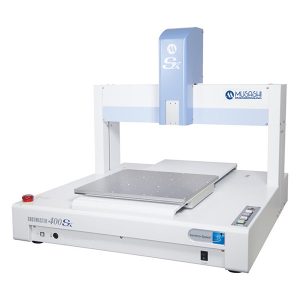
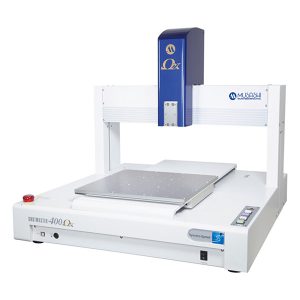
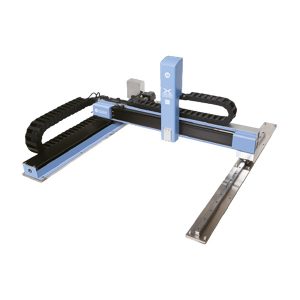
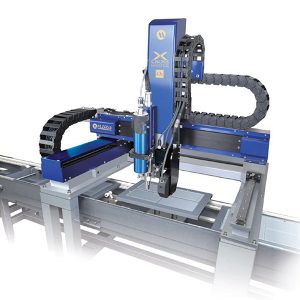
Accelonix also provides local technical expertise and support throughout the UK and Ireland, covering both the dispenser itself and the wider range of Musashi robotic dispensing systems with which it can be synchronised.
Discuss an ultra-micro dispensing application
Manufacturers developing medical devices, sensors, microfluidic products or advanced electronic assemblies can contact Accelonix UK & Ireland to discuss their materials, target dispense volumes and automation requirements.
Application trials can help determine the most appropriate dispensing method, nozzle configuration, material handling approach and level of automation before production implementation.