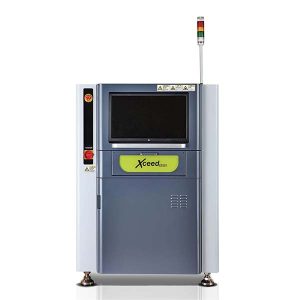
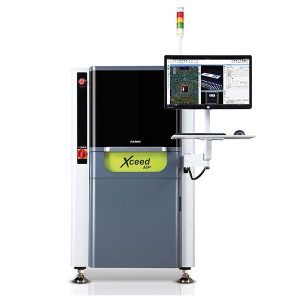
Inspection plays a decisive role in ensuring the reliability of PCBs and the safety of finished products. Every undetected defect can have serious consequences, whether in medical devices, automotive applications or aerospace equipment. For more than twenty years, AOI (Automatic Optical Inspection) has constantly evolved, moving from rudimentary 2D systems to high-precision 3D platforms. Today, artificial intelligence is taking this evolution even further by automating the entire inspection cycle, from auto-teaching to auto-tuning.
From 2D AOI to 3D AOI: increasing precision
The first 2D AOI systems marked a decisive step forward for the industry. They replaced tedious manual inspection with automated visual analysis, quickly detecting missing, misaligned or misplaced components. However, these systems relied solely on two-dimensional images and comparison with reference models.
Their limitations soon became evident: strong sensitivity to lighting variations, solder reflections, differences in silkscreen, and above all, the inability to measure solder height or volume. The result was a high number of false defects, forcing operators to spend significant time on secondary verification.
The move to 3D opened new perspectives. With laser profiling or fringe projection, AOI became able to measure solder height, component coplanarity and deposit regularity in volume. Defects previously invisible in 2D could now be detected reliably, notably on BGAs, QFNs and other complex packages. The reduction in false defects lightened the operators’ workload and improved overall quality.
Yet while 3D AOI delivered precision, it did not completely resolve two major challenges: the time required for initial programming and the management of residual false defects. These are precisely the issues addressed by Parmi’s AI.
3D AOI enhanced by artificial intelligence
With the integration of AI in Xceed, 3D AOI reaches a new level. Rather than being limited to static algorithms, it learns, adapts and optimises continuously. Parmi has structured the contribution of AI around five key steps: teaching, inspection, verification, debugging and tuning.
AI Teaching: rethinking programming
Teaching has always been the most time-consuming stage, highly dependent on the programmer’s expertise. Traditionally, each component had to be manually matched to a reference library. Now, AI Teaching automates the entire process.

With a database enriched by more than one million components, the AI recognises the majority of parts found on a board (ICs, resistors, capacitors, diodes, transistors, connectors, coils, etc.), including exotic components. It requires only the PCB and, if necessary, the BOM — without Gerber files. The time saving is remarkable: a panel with 2,354 components can be taught in just 2 minutes 30 seconds. This radically changes new product introduction and frees the programmer from repetitive tasks, allowing focus on special cases.
AI Inspection: robustness against variation

AI also enhances the inspection phase. AI OCR (Optical Character Recognition) reads markings with unprecedented accuracy, even with font variations, contamination or low contrast. Where traditional OCR generated many false defects, AI drastically reduces errors and improves continuously through re-learning.

Similarly, AI Polarity automatically recognises polarity marks regardless of their shape, background or colour. AI Lead Finding identifies the position of leads even when their colour varies, ensuring consistent solder inspection.
By strengthening the robustness of analysis, AI limits false defects and secures detection under real production conditions.
AI Verification: the automated second look
After inspection, secondary verification is vital to prevent false defects from disrupting production. Historically carried out by operators, this stage is now largely automated.

With AI Verification, the Veriworks software manages the analysis of defects flagged NG by the AOI. The AI generates a judgement file and integrates it directly via the MES interface. Operators only intervene on residual cases.
This automation results in shorter verification times and increased productivity. Operators can focus on essential tasks, while the AI handles the majority of secondary checks.
Auto Tuning: continuous optimisation
The final brick in the process is Auto Tuning. Instead of fixing pass/fail tolerances, the AI adjusts them automatically according to production history and observed false defects.
This dynamic setting guarantees continuous optimisation and stabilises yields over the long term. AOI no longer merely detects: it learns from results and adapts its criteria to maintain the best balance between sensitivity and productivity.
Auto Debugging: simplifying adjustments
Every AOI programmer knows the burden of debugging: adjusting inspection areas (ROIs), correcting parameters, adapting criteria. Auto Debugging in Xceed automates these tasks, corrects errors from teaching and drastically reduces manual intervention.
This not only saves time but also ensures greater consistency between different programmes, regardless of the operator’s skill level.
Overall impact
With this approach, 3D AOI becomes an intelligent, evolving system. The benefits are clear:
- Significant reduction in programming time.
- Notable decrease in false defects.
- More robust inspection in the face of variation.
- Productivity gains for operators.
- An inspection process that self-corrects and continuously improves.
AI does not replace the programmer’s role: it transforms it. No longer absorbed by repetitive tasks, the programmer focuses on validation, optimisation and special cases.
SmartON, the bigger picture
While 3D AOI enhanced by AI makes each machine smarter, industrial efficiency also depends on the line level. This is where SmartON, Parmi’s centralised supervision solution, comes in.
SmartON makes it possible to monitor line yield in real time, analyse defects by component type, manage inspection programmes and keep software up to date. With its monitoring, reporting and remote-control functions, it transforms AOI into an integrated component of a connected ecosystem. The future of inspection therefore rests on synergy: the local intelligence of 3D AOI with AI and the global intelligence of SmartON. Together, they deliver faster, more reliable inspection, fully integrated into the logic of connected manufacturing.